Do Soundproof Curtains Actually Work? The Truth (Plus a DIY Fix That Does)
This article contains affiliate links. If you buy something through one of them, we may earn a commission at no extra cost to you. See our disclosure policy for details.
No, a curtain labeled "100% soundproof" for twenty dollars will not soundproof your window. Fabric alone cannot block low-frequency bass or impact stomps. But real acoustic curtains, and a specific DIY layering trick, do measurably help. Here's the difference.
The myth: "100% soundproof" curtains
Cheap curtains marketed as fully soundproof are almost always just thick blackout fabric. Blackout and soundproofing are different jobs: one blocks light, the other needs mass and density to slow down sound waves. A curtain can do the first easily and the second only marginally.
The truth: what real acoustic curtains are made of
Curtains that genuinely reduce noise are heavy, and usually lined with an industrial material like mass-loaded vinyl or dense felt layers, similar to the products used in professional studio treatment. Brands built specifically for acoustic use, rather than blackout use, are the ones worth considering if you want a curtain to do real work.
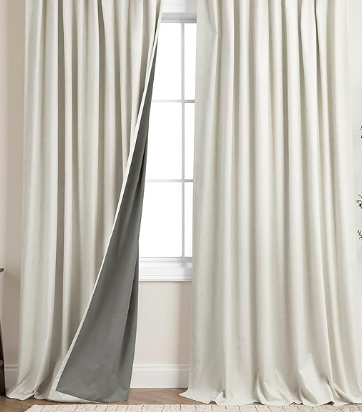
Recommended: MLV-lined or felt-lined acoustic curtain.
The DIY hack that actually works
If a genuine acoustic curtain isn't in the budget, hang two layers of thick blackout curtains on double curtain rods with thick bath towels layered in between. Sound engineers have found that multiple layers of tightly woven terry cloth towels provide surprisingly good absorption for mid-to-high frequency sound, effectively turning a blackout curtain into a rough approximation of a padded acoustic curtain.
Do this: hang your existing blackout curtain on the inner rod, layer bath towels flat between the two rods, then hang a second curtain on the outer rod to hide the towels.
What curtains can and can't fix
Curtains, even good ones, work best on mid and high-frequency sound like voices, traffic hum, and TV audio. They do very little against bass or impact noise like footsteps and slamming doors, that kind of noise needs mass on the wall or window itself, not fabric in front of it. See our guides on soundproofing windows and soundproofing a bedroom wall for the fixes that handle bass and impact noise.
FAQ
Are any curtains actually "100% soundproof"? No curtain fully blocks sound. The phrase is a marketing term, not an acoustic measurement. The best curtains meaningfully reduce noise, they don't eliminate it.
Is the towel-layering trick really as good as a real acoustic curtain? It's a solid budget alternative for mid and high-frequency sound, but a genuine MLV or felt-lined curtain will outperform it, especially for anything approaching low-frequency noise.
Do soundproof curtains help with echo inside my own room, or just outside noise? Both, to a degree. Heavy fabric absorbs some of the reflected sound bouncing around your room in addition to muffling some sound coming through the window.
Should I buy curtains before or after sealing my window? After, or at the same time at minimum. A curtain over a poorly sealed, single-pane window is treating a symptom. Sealing the window first, as covered in our window inserts guide, gives the curtain something worthwhile to add to.
The renter's bottom line
Skip the twenty-dollar "soundproof" curtains, they're blackout curtains with a misleading label. If you want real results, either buy a genuine MLV or felt-lined acoustic curtain, or layer bath towels between two blackout curtains for a comparable budget fix.
Part of our complete guide to apartment noise.