How to Soundproof an Apartment Door in a Rental (No Damage, No Deposit Loss)
This article contains affiliate links. If you buy something through one of them, we may earn a commission at no extra cost to you. See our disclosure policy for details.
Why your door is the weakest link
Doors are the biggest acoustic hole in most apartments. They're thin, hollow-core, and — most importantly — surrounded by air gaps. Here's the counterintuitive part: the gaps matter more than the door itself. Sound leaks through air, and a quarter-inch gap under the door can pass more noise than the entire door panel.
That's good news for renters, because sealing gaps is cheap, reversible, and deposit-safe.
Do these in order (cheapest and most effective first)
1. Seal the bottom gap — the single biggest win
The gap under the door is usually the loudest leak. Two renter-safe options:
- A door sweep (screw-on or the peel-and-stick renter versions) that presses against the floor.
- A weighted door draft stopper you just set in place — zero installation, zero damage, and it doubles as draft/heat control.
Start here. This one move often produces the most noticeable difference for the least money.
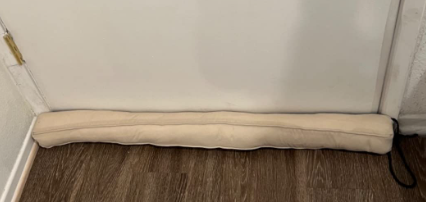
Recommended: a weighted door draft stopper — no installation required, and usually the highest-converting product for renters.
2. Seal the perimeter gaps
Run your hand around the door frame with the door closed. Feel air? That's sound getting through.
- Adhesive foam weatherstripping tape around the frame closes the side and top gaps.
- It peels off cleanly at move-out, so it's lease-friendly.
3. Add mass to the door panel (the "ugly but it works" option)
Let's be honest up front: acoustic door blankets work, but they're not pretty. These are thick, quilted panels—often mass-loaded vinyl wrapped in fiberglass—that hang over your door on grommets or a rod. Acoustically, they do the job. The extra mass blocks a real chunk of airborne noise, especially if you're dealing with a cheap hollow-core door or sound leaking around the frame.
The problem is how they look. There's no getting around it—a door blanket gives your entryway the vibe of a freight elevator padded for a furniture move. In a bedroom, home office, or any space you actually live in, that industrial look is a lot to stomach. For most renters, it's a dealbreaker.
So here's our take: a door blanket makes sense when function truly beats form—a nursery, a temporary setup, a work-from-home corner nobody sees on video calls. If that's you, it's a cheap, effective fix.
But if you care how the room looks (and most of us do), you'll get most of the benefit with better-looking options:
- Seal the gaps first. A door sweep and weatherstripping cost a few dollars, install in minutes, and are completely invisible. Most door noise sneaks through the gaps, not the door itself—so this is the highest-ROI move you can make.
- Layer a heavy curtain over the door. A thick, floor-length curtain on a rod above the frame adds mass like a blanket does, but reads as an intentional design choice instead of moving-day gear.
- Upgrade the door itself (if you own, or your landlord's flexible). Swapping a hollow-core door for solid-core is the real fix, and it looks like nothing changed at all.
Bottom line: door blankets earn their place in the "ugly but it works" category. We'd reach for the gap-sealing and curtain route first, and save the blanket for spaces where looks genuinely don't matter.
4. Absorb echo in the entryway (optional finish)
If your entry hall is hard-surfaced and echoey, a rug and a soft surface nearby reduce the ring that makes hallway noise feel louder.
What NOT to waste money on
- Acoustic foam on the door looks like it should work and doesn't do much for actual sound transmission — it's for echo, not blocking.
- "Soundproof" curtains alone help at the margins but won't fix an unsealed door.
Being upfront about this is what makes the rest of this guide worth trusting.
The renter's bottom line
Seal the bottom, seal the perimeter, add mass. Total spend is usually $30–80, everything is reversible, and you'll get the majority of the achievable improvement from step 1 alone.
Once your door is handled, our best white noise machines guide covers the next-highest-leverage fix for whatever noise still gets through. Guides on soundproofing windows and shared walls are on the way.
Part of our complete guide to apartment noise.